
Which Power Supply Do I Need?
How to pick the right replacement power supply: matching the connector, the rails and the current rating, and knowing when an adapter is safe.
August 5, 2026
Three things have to match before a power supply is right for your machine: the connector, the rails, and the current rating. A supply that gets two of the three correct is not two-thirds right — it is wrong, and depending on which one is missing it may be dangerous.
Here is how to check each of them.
1. Identify the machine, not just the family
"A Commodore" is not enough, and neither is "an Atari". Within a single family the requirements change completely:
| Machine | Connector | Rails |
|---|---|---|
| Commodore 64 | 7-pin round DIN | +5V DC and 9V AC |
| Commodore 128 | 5-pin square DIN | +5V DC and 9V AC, more current |
| Commodore Plus/4 | square DIN | +5V DC and 9V AC |
| Amiga 500 | 5-pin square DIN | +5V, +12V, -12V DC |
| Amiga CD32 | round DIN | +5V and +12V DC |
| Atari XL / XE | 7-pin round DIN | +5V DC only |
| Atari 520ST / 260ST | 7-pin round DIN | +5V, +12V, -12V DC |
| ColecoVision | 4-pin rectangular | +5V, +12V, -5V DC |
Read the model number off the case, not off the box it came in. Machines get swapped between cases far more often than you would expect.
2. Match the connector — but do not trust it
The connector is the first filter, and it is the one that misleads people. Several of these machines share a shell while carrying entirely different rails:
- Commodore 64 and Atari XL/XE both use a 7-pin round DIN. The C64 puts 9V AC on two contacts. The Atari expects +5V and ground there.
- Atari XL/XE and Atari 520ST both use a 7-pin round DIN. One rail versus three.
- Commodore 128 and Amiga 500 both use a 5-pin square DIN. +5V and 9V AC versus +5V, +12V and -12V.
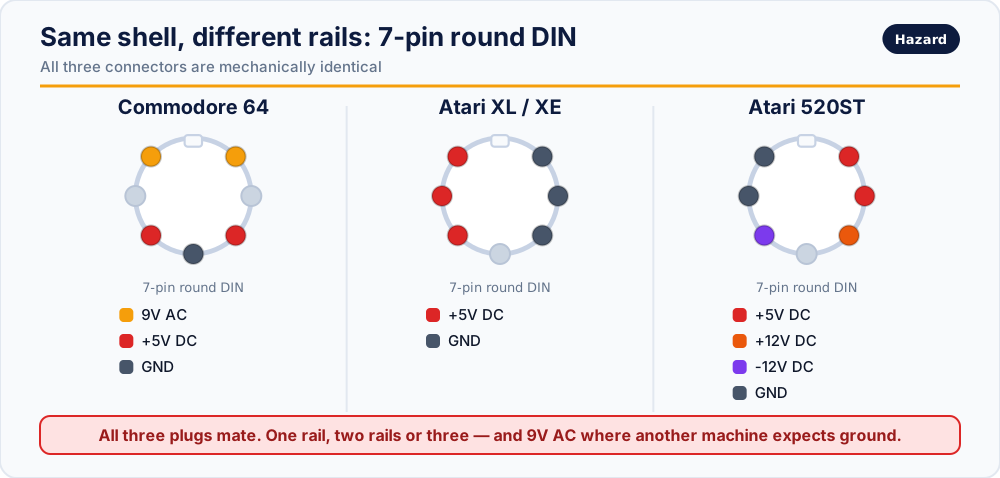
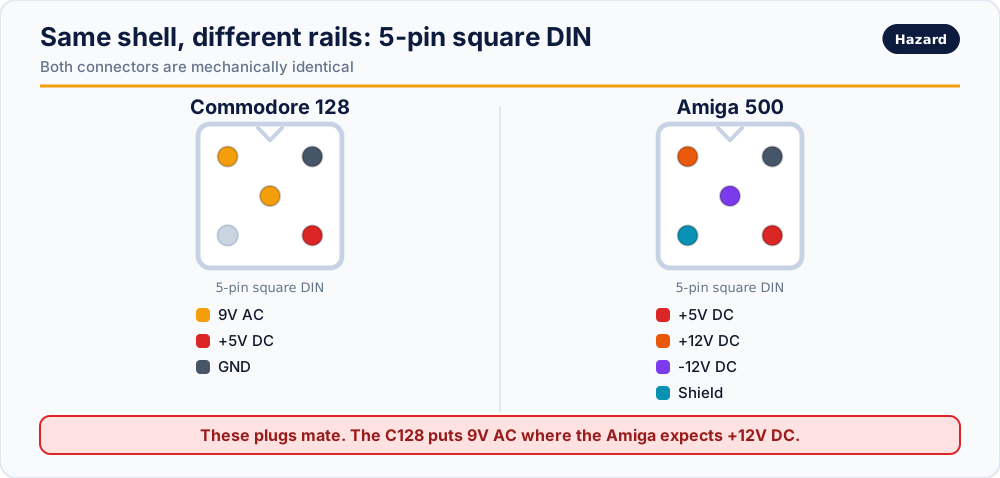
In every one of those pairs the plug fits and the machine is damaged. The fact that a plug fits tells you nothing. Match the label, then verify with a meter.
The full contact-by-contact diagrams are in the quick reference.
3. Match the rails exactly
Every rail the machine expects must be present, at the right polarity.
Missing rails produce faults that look like anything but a power problem. A ColecoVision without its -5V rail shows graphical corruption, because that rail feeds period DRAM. An Amiga without its -12V rail runs games perfectly and fails only when something uses the serial port. Neither one looks like "the power supply is wrong", which is exactly why both waste so much diagnostic time.
A negative rail that reads positive is not a minor error — it is a supply you must not connect.
4. Match — or exceed — the current rating
Current works differently from voltage, and this is the part most often misunderstood.
Volts are what the machine demands. Too high destroys it; too low means it will not run.
Amps are what the supply can deliver. The machine draws what it needs and no more. A supply rated higher than the machine requires is not dangerous — it is running comfortably instead of at its limit, which is why it will last longer.
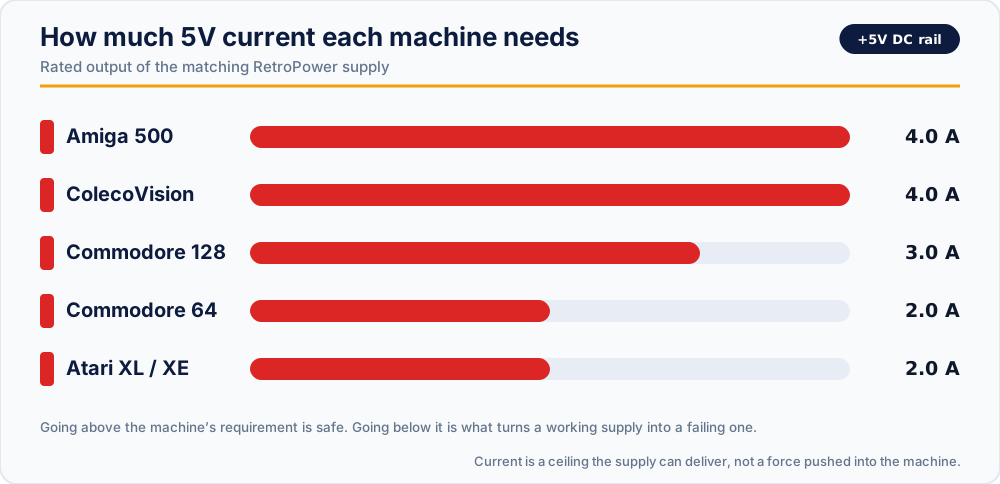
So: never go below the required rating, and going above it is a benefit rather than a risk. If you are choosing between a supply rated exactly at the machine's draw and one with headroom, take the headroom.
There is more on this in Volts, amps and 9V AC explained.
5. When is an adapter safe?
Adapters between connector styles are legitimate — a C128-to-C64 adapter, for instance, lets one supply serve two machines.
The rule is simple: an adapter changes the shape of the plug, never the capacity of the supply behind it.
- Adapting a C128 supply down to a C64 is fine: the rails match and the 3.0 A supply comfortably covers a machine that needs 2.0 A.
- Adapting a C64 supply up to a C128 is not: the same rails, but now a 2.0 A supply is being asked for 3.0 A, permanently, which is how a working brick becomes a failing one.
Adapt upward in capacity, never downward. And never use an adapter to bridge machines whose rails differ — no adapter turns 9V AC into +12V DC.
6. Choose the mains plug for your region
Our supplies ship in two variants:
- US — 120 V AC input, US-standard plug.
- International — 230 V AC input, with EU, UK or AU/NZ cable.
This is about the wall socket, not the machine. A C64 is a C64 everywhere; only the input side changes.
One regional detail does reach the machine: on Commodore hardware the 9V AC rail drives the CIA Time-of-Day clocks by counting mains cycles. A machine running on a 60 Hz supply where the software expects 50 Hz will keep incorrect time in programs that use that clock. It is not a fault and it harms nothing — but it explains an otherwise baffling symptom.
7. Decide between the standard and OLED models
Both deliver identical, fully regulated power. The OLED models add a display and touch panel that show output voltages, uptime, internal temperature and AC frequency, and allow the output voltage to be trimmed.
If you want to see what the supply is doing rather than reach for a meter, the OLED version pays for itself the first time you check a rail. Otherwise the standard model is the same electrical product.
Still unsure?
Send us the model number from the machine's case and a photograph of its power socket. That is enough for us to identify the right supply, and it is a much better use of everyone's time than a guess.