
Original vs Modern Power Supply
Why forty-year-old power bricks destroy the computers they were built for, what actually fails inside them, and what a modern replacement changes about that.
August 21, 2026
There is a widely repeated claim in retro computing that original Commodore power supplies destroy the machines they came with. It is unusual for a claim like that to be both alarmist-sounding and true, but this one is. It is worth understanding why, because the reason is specific and it changes what you should do about it.
The design decision at the root of it
On a Commodore 64, the +5V rail arrives from the external brick already regulated. There is no second regulator inside the computer standing between the supply and the chips.
In 1982 that was a sensible trade. Regulation generates heat, and moving it outside the case kept the computer cool and cheap. The unstated assumption was that the regulator would fail safely, or that the machine would be obsolete before the regulator aged out.
Neither turned out to be true.
What actually fails, and how
The 5V regulator in an original Commodore brick sits potted in epoxy — the whole assembly is filled with resin, partly for safety and partly to discourage repair.
That has three consequences, and they compound:
- It cannot dissipate heat well. Epoxy is a poor conductor. The regulator runs hot for its entire life, and heat is what ages semiconductors.
- It cannot be inspected or serviced. You cannot see a bulging capacitor, re-cap it, or replace the regulator. There is nothing to check and nothing to fix.
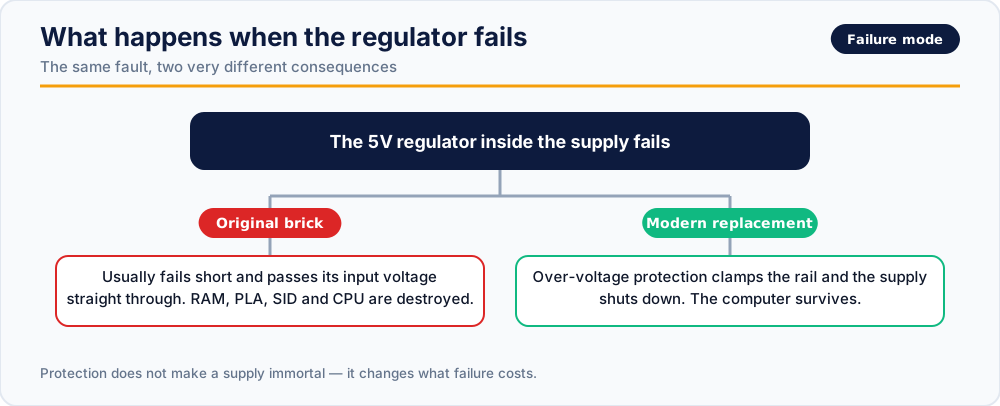
- When it fails, it usually fails short. A shorted series regulator does not stop conducting — it passes its input voltage through to its output. The unregulated input inside these bricks is well above 5 V.
So the failure mode is not "the computer stops getting power". It is "the computer gets ten or twelve volts on a bus designed for five", for as long as it takes someone to notice the screen looks wrong. On the way through, that takes out RAM, the PLA, the SID and often the CPU.
Why it gets worse rather than better
Two things make the risk grow over time.
Age is cumulative. Every hour a potted regulator spends hot is an hour of wear that cannot be reversed or inspected. A brick that has worked for forty years is not proven reliable; it is forty years closer to failing.
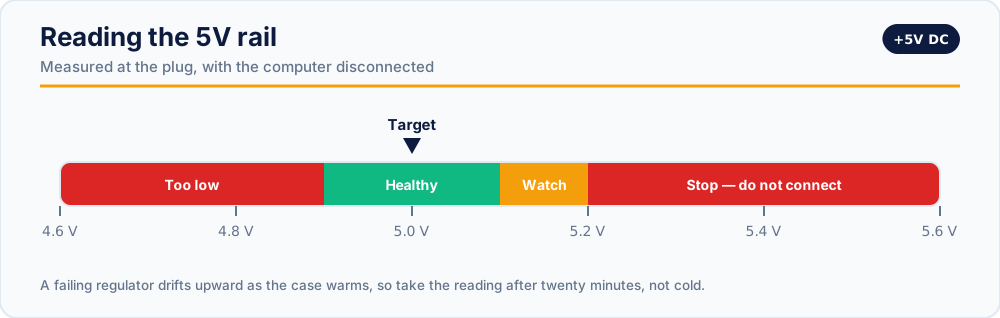
The failure is not announced. A supply drifting from 5.0 V to 5.3 V still runs the machine. It looks fine. The drift continues, and the point at which it stops looking fine is past the point at which damage begins. This is the part that catches careful people: "it was working perfectly yesterday" is the normal history of a brick that has just destroyed a computer.
What a modern supply changes
A modern replacement is a different circuit, not a refreshed version of the same one. The differences that matter:
| Original brick | Modern replacement | |
|---|---|---|
| Regulation | Linear, potted in epoxy | Switched-mode, serviceable design |
| Over-voltage protection | None | Yes — the rail is clamped |
| Over-current protection | Fuse, sometimes | Yes, per rail |
| Failure mode | Frequently fails short, passing input through | Shuts down instead of passing through |
| Heat | Runs hot by design | Runs cool |
| Fusing | AC side only, often internal | Both AC and DC sides |
| Isolation | Varies | Full isolation between sides |
| Inspectable | No | Voltages visible on the OLED models |
The single most important line in that table is the failure mode. Protection circuitry does not make a supply immortal — it makes the consequence of failure a supply that stops working rather than a computer that stops existing.
Is an original supply ever the right choice?
For a display machine that will never be switched on, or for a collection where originality is the point, keeping the original brick is entirely reasonable. Keep it, label it, and do not plug it in.
For a machine you intend to actually use, no. The original supply is the highest-risk component in the system, its risk cannot be assessed by inspection, and the thing it puts at risk is worth considerably more than a replacement supply.
If you want to keep using an original brick anyway
That is your call to make, and there are things that reduce the risk without eliminating it:
- Measure it before every session, not once. A drifting regulator drifts further.
- Measure it warm, after twenty minutes, not cold — cold readings hide the fault.
- Fit an external over-voltage protector between the brick and the machine. Several exist for the C64 specifically; they clamp or disconnect the rail if it rises.
- Never leave the machine powered unattended.
- Accept the residual risk honestly. Protection added outside the brick reduces exposure; it does not make a forty-year-old potted regulator trustworthy.
The step-by-step measurement procedure is here.
Replacement supplies
- Commodore 64 — US · International
- Commodore 128 — US · International
- Amiga 500 — US · International
- ColecoVision — US · International
- Atari XL / XE — US · International
Related reading
- Which power supply do I need?
- Volts, amps and 9V AC explained
- Retro power connectors: quick reference
Vintage power supplies contain mains-voltage circuitry and can hold a dangerous charge after being unplugged. If you are not experienced with mains electricity, do not open one.