
Volts, Amps and 9V AC Explained
What a power supply specification means in plain language: why a higher amp rating is safe, why voltage is not, and why Commodore wants 9V AC.
July 29, 2026
Every power supply on this site is described with a line like "stabilised 5V/2.0A DC output, transformer-generated 9V/1.1A AC output". If that means nothing to you, this page unpacks it. No electronics background assumed.
Volts: what the machine demands
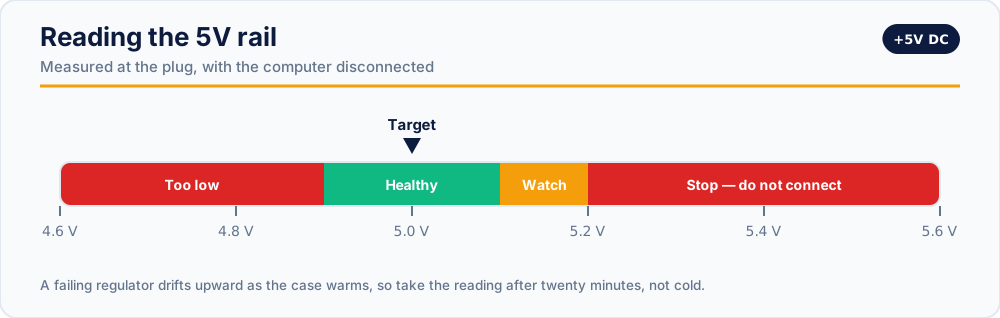
Voltage is the part that is not negotiable. The chips inside a Commodore 64 are designed for 5 volts, and they mean it: meaningfully less and the machine will not run, meaningfully more and the chips are destroyed.
The useful mental model is water pressure. Too little and nothing flows; too much and the pipes burst. You do not get to choose the pressure — the machine already chose it.
This is why a supply must match the required voltage exactly, and why an over-voltage fault is catastrophic rather than merely inconvenient.
Amps: what the supply can deliver
Current is the part almost everyone gets backwards on the first encounter.
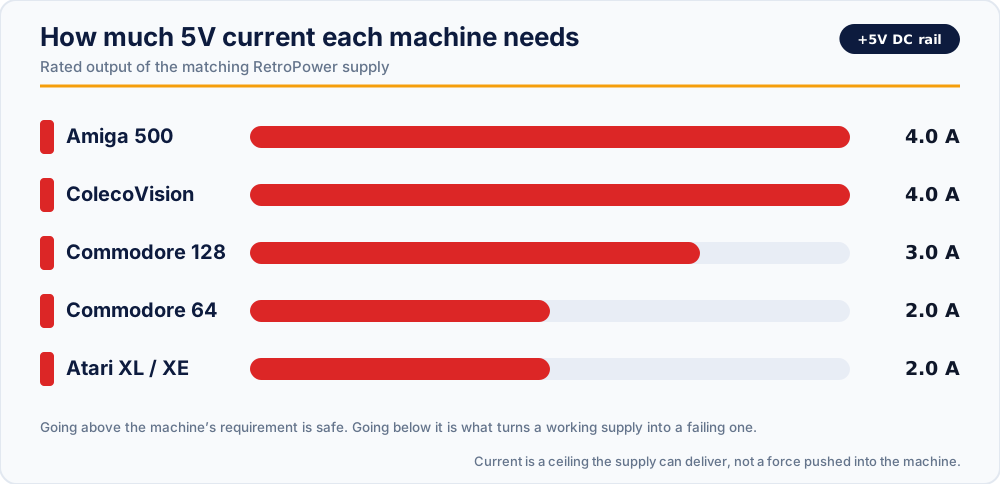
Amps are a capacity, not a force. The machine draws the current it needs; the supply's rating says how much it is able to provide before it struggles. A supply rated at 4 A connected to a machine that draws 2 A does not push 4 A into it. It delivers 2 A and spends the rest of its life running comfortably.
Which gives one simple rule:
- Below the required rating: unsafe. The supply runs at its limit, gets hot, sags under load, and ages fast. This is how a working brick becomes a failing brick.
- At the rating: acceptable.
- Above the rating: better. More headroom, less heat, longer life. There is no penalty.
If you are choosing between a supply rated exactly at your machine's draw and one with margin, take the margin.
DC and AC: two different things on the same connector
DC — direct current — flows one way and has a fixed positive and negative. Every digital chip in these machines runs on DC.
AC — alternating current — reverses direction many times a second. It has no fixed polarity, which is why an AC rail needs two conductors and neither of them is "the positive one".
Most machines take only DC. Commodore's 8-bit machines are the interesting exception: a C64 or a C128 takes +5V DC and 9V AC together, through the same connector.
Why 9V AC, and why it is not converted for you
It would have been simple for Commodore to rectify that 9V AC inside the brick and deliver DC. They deliberately did not, because the machine wants the alternating waveform itself for two jobs:
1. To make the internal +12V. The SID sound chip and parts of the video circuitry need 12 volts. Rather than ship a third rail, the machine rectifies and multiplies the 9V AC internally to produce it.
2. As a clock. The two CIA chips contain Time-of-Day counters, and those counters literally count mains cycles — 50 per second in Europe, 60 in North America. The AC rail is the timebase.
That second point has a visible consequence. A machine running on a supply whose AC frequency does not match what its software expects will keep incorrect time in anything that uses the TOD clock. Nothing is damaged and nothing is broken; the clock is simply counting at a different rate than the program assumes.
It also explains why "just use a 9V DC adapter" does not work. A DC rail has no cycles to count and no waveform to multiply. The machine needs the shape of the signal, not only its energy.
Negative rails: -5V and -12V
Some machines list rails with a minus sign. These confuse people because the current involved is tiny — often 0.1 to 0.5 A — which makes them look optional. They are not.
A negative rail means a voltage below the ground reference rather than above it. Two classic uses appear in these machines:
- Period DRAM. Memory chips of the 4116 generation need +12V, +5V and -5V all at once. This is why a ColecoVision needs three rails to run a games console.
- Serial line drivers. The RS-232 standard requires the signal to swing both above and below ground, so a machine with a serial port needs a negative supply to produce a compliant signal. This is what the Amiga's -12V rail is for.
Both cases produce confusing faults when the rail is missing. A ColecoVision with no -5V shows graphical corruption that looks like a video problem. An Amiga with no -12V boots, runs games perfectly, and fails only when something touches the serial port.
A negative rail must measure negative. If your meter shows a positive number where -12V is expected, either your probes are reversed or the supply is wired incorrectly. In the second case, do not connect it.
"Stabilised", "anti-ripple", "isolated": the rest of the vocabulary
Stabilised (or regulated) — the output voltage is actively held at its target regardless of load and mains variation. An unregulated supply's output rises when lightly loaded and sags when worked, which is exactly the behaviour vintage chips tolerate least.
Anti-ripple filter — smooths the small residual waviness left over from converting AC to DC. Ripple on a logic rail shows up as instability rather than as a clean failure.
Over-voltage protection — circuitry that clamps or shuts down the output if the voltage rises above its limit. This is the specific protection that the original Commodore bricks lack, and the specific failure that destroys machines.
Over-current protection — shuts the supply down if too much current is drawn, which is what should happen when a peripheral shorts.
Fused on AC and DC side — separate fuses on the mains input and the low-voltage output, so a fault on either side is contained.
Fully isolated — no electrical path between the mains side and the low-voltage side. A safety property, and not one to compromise on with improvised supplies.
Reading a real specification
Take the C64 line from earlier:
Stabilised 5V/2.0A DC output with anti-ripple filter · transformer-generated 9V/1.1A AC output
Which reads as: a direct-current rail held steady at 5 volts, able to supply up to 2 amps, smoothed. Plus an alternating-current rail at 9 volts, up to 1.1 amps, produced by a transformer winding. Both are what the C64 expects, with the current ratings sized above what the machine draws.