
ZX Spectrum Power Supply Pinout
What sits on each contact of the ZX Spectrum's 6-pin round DIN power connector, why two of its three rails exist purely for the memory chips, and how to check a supply safely.
August 19, 2026
Most people picture the ZX Spectrum being powered by a small black barrel-jack brick, and for the original machine that is exactly right. The supply documented here is the multi-rail one: a 6-pin round DIN delivering +5V, +12V and −12V, for machines and configurations that need all three brought in rather than generated internally.
The interesting part is what two of those three rails are for. They do not power the processor, the video hardware or the sound. They power the memory — and nothing else.
Read this first. Contact positions are shown as you look into the socket on the computer, with the keyway at the top. Looking at the plug instead mirrors the picture left-to-right. Confirm every rail with a multimeter before you solder anything.
The power connector
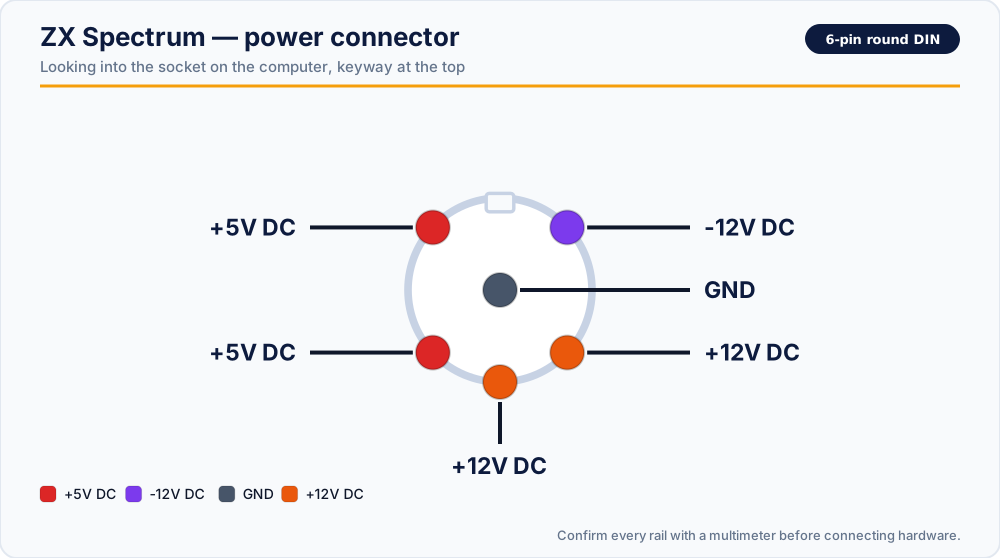
| Position | Rail |
|---|---|
| Upper left | +5V DC |
| Upper right | -12V DC |
| Centre | GND |
| Lower left | +5V DC |
| Lower right | +12V DC |
| Bottom centre | +12V DC |
Every contact is labelled on this one — there are no unknowns to work around.
Two things to notice. Ground sits in the centre, not at the edge, which is unusual enough that it is worth confirming before you probe. And both +5V and +12V are doubled across two contacts each, for the usual reason: a DIN contact has a modest current rating, and splitting the load keeps each contact inside it. Wire both of each pair.
Why three rails for one small computer
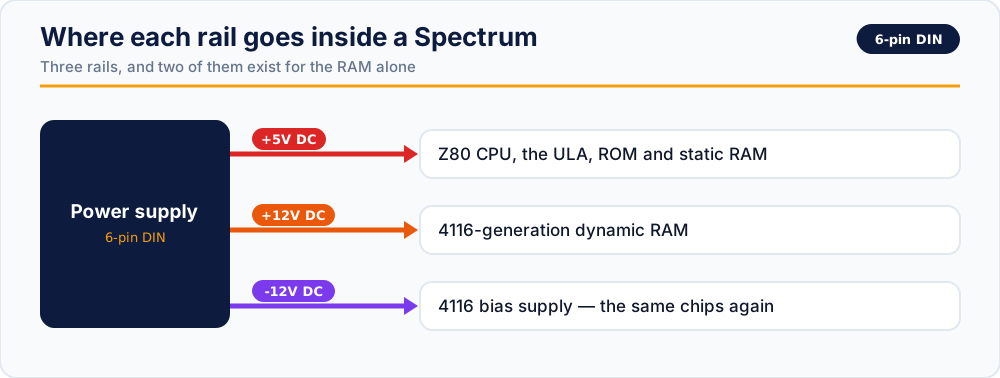
The answer is the RAM, and it is the same answer as on the ColecoVision and the TI-99/4A.
Dynamic RAM of the 4116 generation predates the single-supply memory that came later. A 4116 needs +12V, +5V and −5V (here supplied as −12V at the connector and dropped internally) all present, and it needs them in a particular order at power-up. Three rails arriving at the machine is not a design flourish; it is what those chips demand.
That gives the practical consequences:
- +5V DC runs the Z80, the ULA, the ROM and the static RAM. This is the rail carrying nearly all the current.
- +12V DC exists for the dynamic RAM.
- −12V DC exists for the dynamic RAM as well — its bias supply.
So a supply that provides a healthy 5V and nothing else will light the machine up and produce nonsense, because the processor runs and the memory does not. That is a much more confusing failure than a machine which simply stays dark.
What our replacement delivers
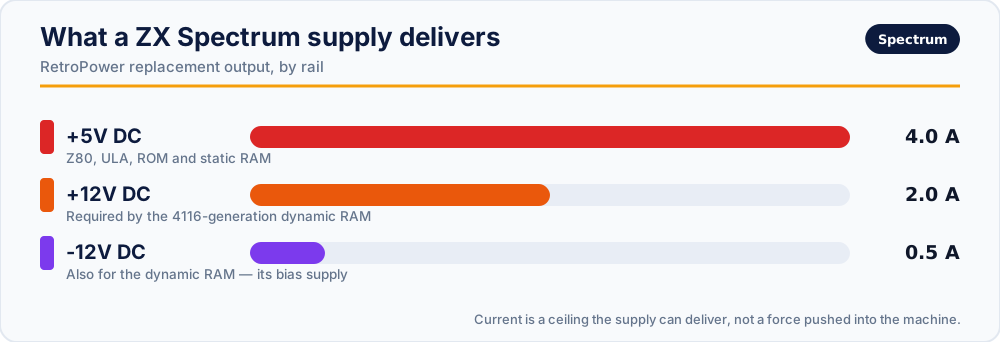
| Rail | Output |
|---|---|
| +5V DC | 4.0 A, stabilised |
| +12V DC | 2.0 A, stabilised |
| -12V DC | 0.5 A, stabilised |
With over-voltage and over-current protection, fusing on both the AC and DC sides, and full isolation between them.
The negative rail's half-amp rating looks negligible next to the other two, and it is — in current. In importance it is equal to them.
Checking a supply before you trust it
With the supply on mains and disconnected from the computer, probe the plug. All measurements are taken against the centre contact.
- Upper-left to centre: expect close to +5.0 V. Repeat for lower-left — both should read the same.
- Lower-right to centre: expect close to +12.0 V. Repeat for the bottom contact.
- Upper-right to centre: expect close to −12.0 V. If your meter shows a positive number, either the leads are reversed or the supply is. In the second case, do not connect it.
- Watch all three rails for a minute. Upward drift on the 5V rail as the case warms is a failing regulator.
- Any rail that is absent, low or drifting is a reason to stop.
Do not judge a rail by wire colour. Replacement cables are built by many different people to no shared convention. The meter is the only authority.
Replacement supplies
- RetroPower PSU ZX Spectrum — US plug · International plug
- RetroPower PSU ZX Spectrum with OLED display — US plug · International plug
Related reading
- Sinclair QL power supply pinout — the other Sinclair, and nothing about it is the same
- TI-99/4A power supply pinout — the same three-rail memory problem
- Volts, amps and 9V AC explained
Vintage power supplies carry mains voltage inside, and can hold dangerous charge after being unplugged. If you are not experienced with mains electricity, do not open one.