
ColecoVision Power Supply Pinout
What sits on each contact of the ColecoVision 4-pin power connector, why the console needs a -5V rail, and how to check a supply safely.
August 17, 2026
The ColecoVision has a reputation for eating power supplies, and the reason is visible the moment you look at the connector: this is a games console from 1982 that needs three separate DC rails, one of them negative, all delivered through a small 4-pin rectangular plug with no margin anywhere.
Read this first. Contact positions are shown as you look into the socket on the console. Looking at the plug instead mirrors the picture left-to-right. Confirm every rail with a multimeter before you solder — putting +12V onto the -5V contact will destroy memory chips instantly.
The power connector
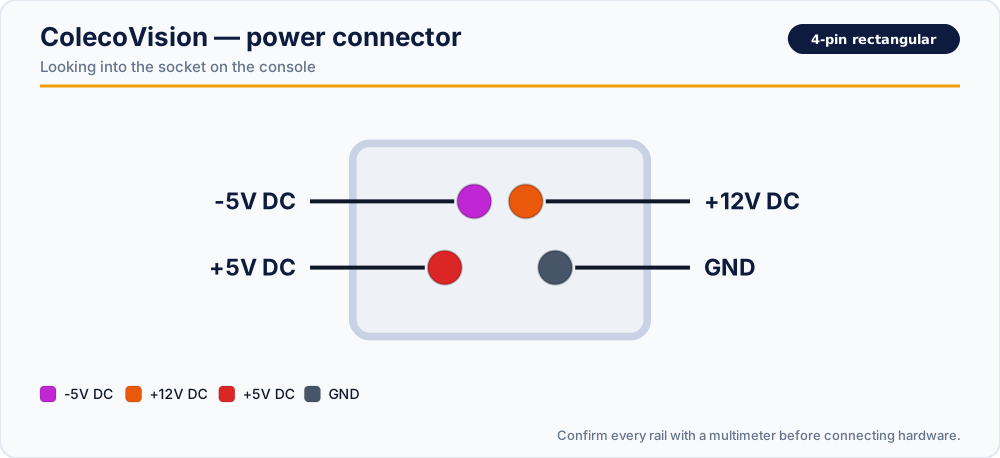
| Position | Rail |
|---|---|
| Upper left | -5V DC |
| Upper right | +12V DC |
| Lower left | +5V DC |
| Lower right | GND |
Four contacts, four rails, nothing spare. Note that the two negative-adjacent contacts — -5V and GND — sit diagonally opposite each other, which is exactly the arrangement that punishes a cable assembled from a mirrored diagram.
Why three rails, and why one is negative
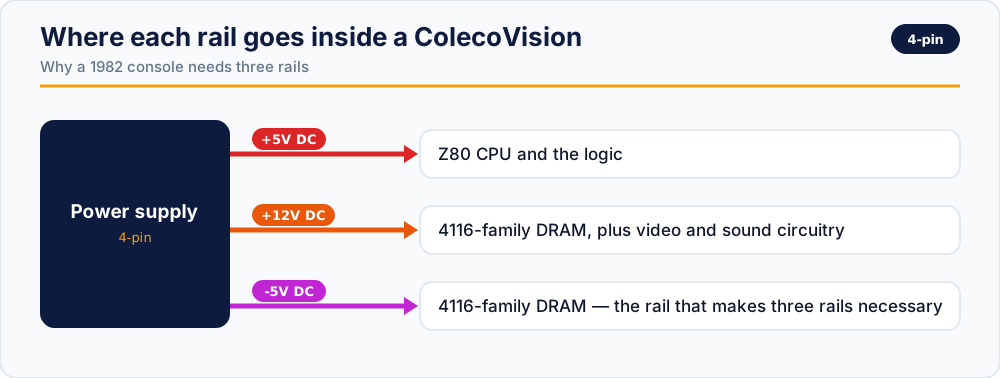
The answer is the memory. The ColecoVision uses period DRAM of the 4116 family, and those chips predate the single-supply designs that came later. A 4116 needs all three of +12V, +5V and -5V to operate, and it needs them in a particular order at power-up.
That single design choice explains most of what people experience with this console:
- The rails are not independent. Losing -5V does not disable one feature; it makes the RAM behave unpredictably, which surfaces as graphical corruption, lock-ups, or a console that plays one cartridge and not another.
- The negative rail carries almost no current but has to be there. It is easy for a marginal supply to lose it while the other two still measure fine.
- A "5V and 12V" supply is not a ColecoVision supply, however well it measures on those two rails.
The +12V rail additionally feeds parts of the video and sound circuitry, and +5V does the usual work of running the CPU and the logic.
Original power supply specifications
Original Coleco bricks were built to a price at a time when three-rail linear supplies were expensive, and forty years of thermal cycling has not improved them. They are among the most common causes of a "dead" ColecoVision that turns out to have nothing wrong with the console itself.
Our replacement supplies target:
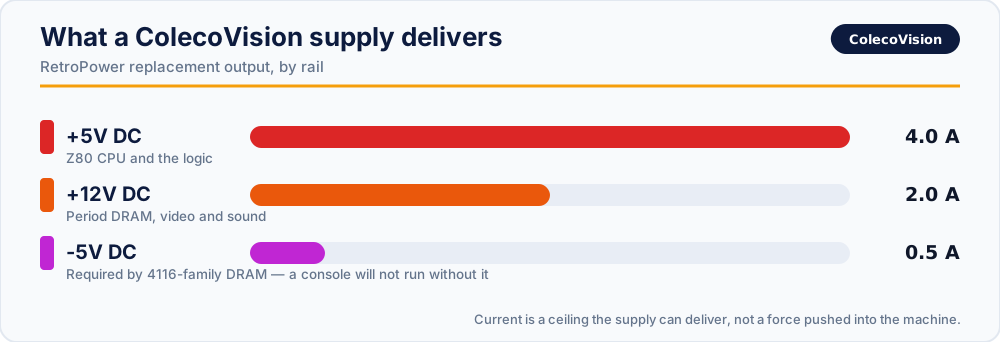
| Rail | Output |
|---|---|
| +5V DC | 4.0 A, stabilised |
| +12V DC | 2.0 A, stabilised |
| -5V DC | 0.5 A, stabilised |
With over-current protection, fusing on both the AC and DC sides, and full isolation. The specialised 4-pin plug matches the original so no adapter is needed.
Checking a supply before you trust it
With the supply on mains and disconnected from the console, probe the plug. All measurements are taken against the lower-right GND contact.
- Lower-left to GND: expect close to +5.0 V.
- Upper-right to GND: expect close to +12.0 V.
- Upper-left to GND: expect close to -5.0 V. A positive reading here means either your leads are reversed or the supply is wired wrongly — in the second case, do not connect it.
- Check all three under load if you can. A failing linear supply frequently measures correctly with nothing attached and collapses the moment the console draws current.
- Any rail that is absent, low, or drifting is a reason to stop.
Do not diagnose a ColecoVision by swapping in "something that fits". The connector is small and unusual enough that improvised supplies are common, and the -5V rail is the one they almost always get wrong.
Replacement supplies
- RetroPower PSU ColecoVision — US plug · International plug
- RetroPower PSU ColecoVision with OLED display — US plug · International plug
Related reading
- Retro power connectors: quick reference — every machine on one page
- Volts, amps and 9V AC explained — how to read a PSU specification
- Which power supply do I need?
Vintage power supplies carry mains voltage inside, and can hold dangerous charge after being unplugged. If you are not experienced with mains electricity, do not open one.